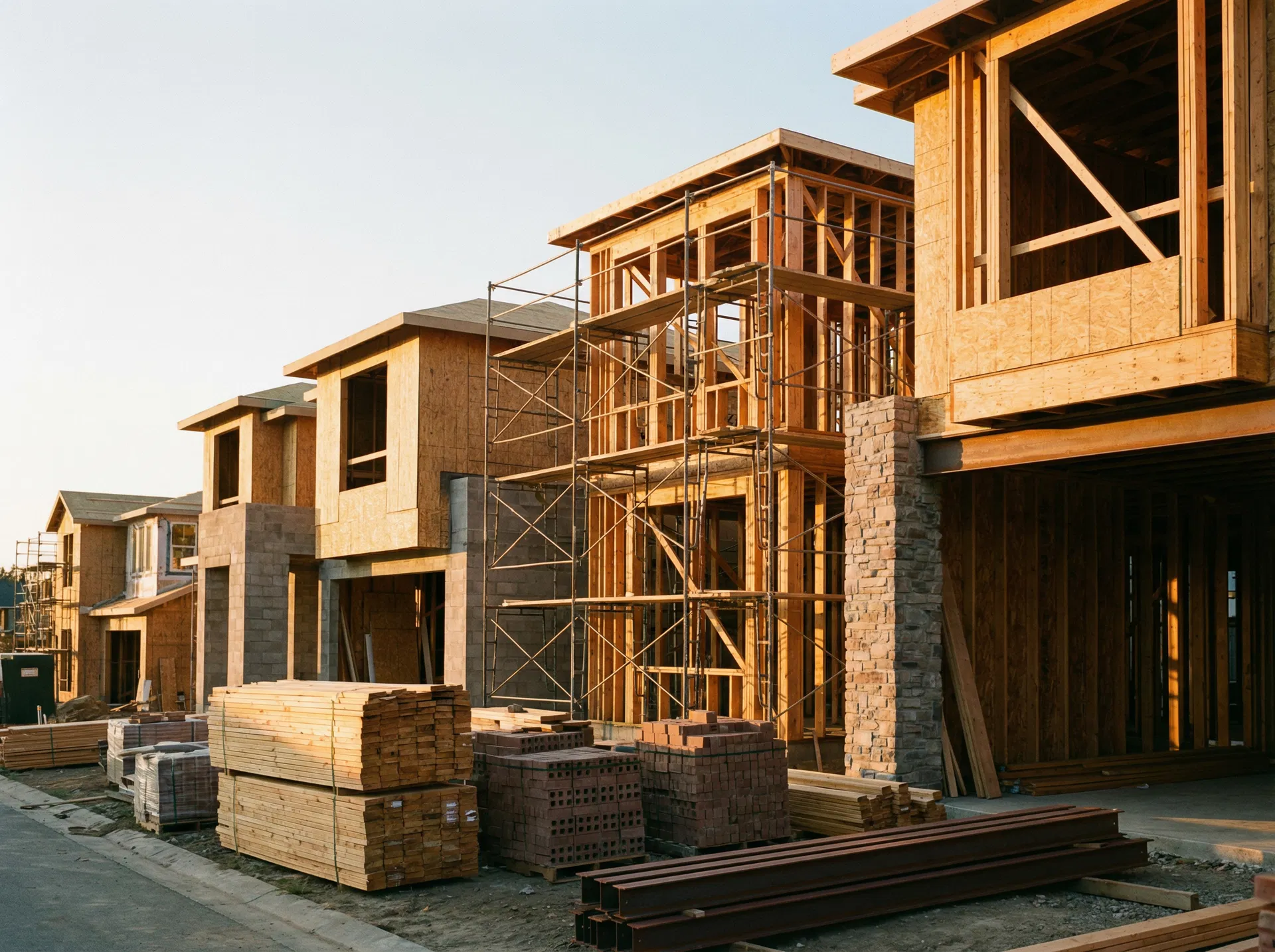
Executive Summary
The U.S. housing and building products ecosystem represents one of the largest and most economically significant sectors in the American economy, with a total addressable market exceeding $800 billion to $1 trillion across building products distribution alone, and total residential construction spending approaching $900 billion annually. The sector sits at the intersection of demographic necessity, interest rate sensitivity, and a structural housing shortage that has been building for over a decade. As of 2025, the United States faces a cumulative housing supply gap of approximately 4.03 million homes, as household formation continues to outpace new construction.
This primer covers the full housing value chain — from raw materials producers through manufacturers, distributors, and ultimately the homebuilders and contractors who construct and renovate the nation's housing stock.
The structural housing deficit is the dominant secular tailwind — the U.S. has underbuilt approximately 3.6 million single-family homes since 2001, and the gap continues to widen. Over 70% of existing homeowners are locked into sub-5% mortgages, creating a "lock-in effect" that suppresses turnover and forces demand toward new construction and renovation.
The distribution layer has emerged as one of the most attractive segments from an investment perspective, characterized by consolidation dynamics, high returns on capital, and recurring revenue streams. The pool and outdoor living sub-sector has matured into a distinct investment category with its own cycle, driven by an installed base of over 5.5 million in-ground pools requiring ongoing maintenance regardless of economic conditions.
Industry Definition & Market Size
The housing and building products sector covers every company involved in the construction, renovation, maintenance, and equipping of residential structures. It can be divided into several distinct but interconnected segments: Homebuilders (top 10 collectively closed over 300,000 homes in 2024, generating combined revenues exceeding $140 billion), Building Products Manufacturers (roofing, siding, HVAC, electrical, plumbing), Building Products Distributors (TAM exceeding $800 billion), and Repair, Remodel & Maintenance (~$620 billion in 2025).
| Segment | Estimated TAM | Key Metric |
|---|---|---|
| U.S. Residential Construction | ~$900B annually | Housing starts, permits |
| Building Products Distribution | $800B–$1T | Distributor revenue, market share |
| Home Improvement / R&R | ~$620B | Existing home sales, home equity |
| Pool & Outdoor Living (Global) | ~$28B | Installed base, new pool builds |
| HVAC (U.S.) | ~$75B | Replacement cycles, regulatory |
| Roofing (U.S.) | ~$55B | Storm damage, age-driven replacement |
| Plumbing / Waterworks | ~$60B | Water infrastructure, code changes |
The Two Demand Drivers: New Construction vs. Repair & Remodel
Understanding this industry requires grasping a fundamental distinction: demand is driven by two largely independent engines. New residential construction is highly cyclical and sensitive to interest rates, land availability, labor costs, and consumer confidence. Repair, remodel, and maintenance (R&R) is significantly more stable and recurring — the aging of the U.S. housing stock (median home age is now ~40 years), combined with homeowners' reluctance to move, has created a strong tailwind for R&R spending.
| Sub-Sector | New Construction % | R&R / Replacement % | Cyclicality |
|---|---|---|---|
| Insulation | ~70% | ~30% | High |
| Lumber & Structural | ~60% | ~40% | High |
| Pool (New Builds) | ~40% | ~60% | Moderate |
| HVAC | ~20% | ~80% | Low-Moderate |
| Roofing | ~15% | ~85% | Low |
| Pool (Maintenance/Chemicals) | ~5% | ~95% | Very Low |
The Housing Value Chain
The housing value chain is a multi-layered ecosystem where raw materials are transformed into finished building products, distributed through wholesale channels, and ultimately installed by contractors and builders into residential structures.
Layer 1: Raw Materials & Commodities
At the base sit producers of raw materials: lumber (Weyerhaeuser, Rayonier), cement and aggregates (Vulcan Materials, Martin Marietta, Summit Materials), steel, copper, PVC resin, and chemicals. Aggregates are a notable exception to the commodity rule — they are heavy, low-value-to-weight products that cannot be economically shipped long distances, creating natural local monopolies with surprisingly strong pricing power.
Layer 2: Building Products Manufacturers
Manufacturers take raw materials and produce finished products. The economics vary enormously depending on where a product sits on the commodity-to-specification spectrum. Commodity products (standard lumber) compete on price. Specified or branded products (James Hardie fiber cement siding with ~90% market share) command premium pricing because switching costs are high. Regulated products (HVAC systems subject to efficiency standards) benefit from mandated upgrade cycles.
| Category | Key Manufacturers | Ticker(s) |
|---|---|---|
| Roofing & Insulation | Owens Corning, GAF (private), Carlisle | OC, CSL |
| Siding & Exteriors | James Hardie, Louisiana-Pacific, Boise Cascade | JHX, LPX, BCC |
| HVAC | Carrier, Trane Technologies, Lennox, Daikin | CARR, TT, LII |
| Plumbing & Water | A.O. Smith, Watts Water, Zurn Elkay, Xylem | AOS, WTS, ZWS, XYL |
| Pool Equipment | Pentair, Hayward, Fluidra | PNR, HAYW, FDR |
| Electrical | Eaton, Hubbell, nVent, Atkore | ETN, HUBB, NVT, ATKR |
| Windows & Doors | Andersen (private), JELD-WEN | JELD |
| Decking & Outdoor | Trex, AZEK | TREX, AZEK |
Layer 3: Distribution
Distributors are the critical logistics layer connecting manufacturers to the fragmented base of contractors. They provide jobsite delivery, technical expertise, credit extension, inventory management, and value-added services. The distribution layer has a TAM exceeding $800 billion.
Layer 4: Contractors, Builders & Remodelers
The end of the value chain consists of professionals who install building products — large national homebuilders, regional builders, and specialized trade contractors. The contractor base is highly fragmented, with over 700,000 residential construction firms in the U.S., the vast majority being small businesses.
Layer 5: Retail Channel
Home Depot ($157 billion revenue, ~2,300 stores) and Lowe's ($83 billion revenue, ~1,700 stores) dominate the retail channel. Home Depot has been aggressively expanding its "Pro" business, including its $18.25 billion acquisition of SRS Distribution in 2024.
Homebuilders: The Demand Engine
The U.S. homebuilding industry has undergone a dramatic structural transformation since the 2008 financial crisis. What was once highly fragmented has consolidated into an industry increasingly dominated by large, publicly traded, professionally managed companies.
| Rank | Company | Ticker | 2024 Revenue | Closings |
|---|---|---|---|---|
| 1 | D.R. Horton | DHI | $33.8B | 93,311 |
| 2 | Lennar | LEN | $33.8B | 80,210 |
| 3 | PulteGroup | PHM | $17.3B | 31,219 |
| 4 | NVR | NVR | $10.3B | 22,836 |
| 5 | Meritage Homes | MTH | $6.3B | 15,611 |
| 6 | KB Home | KBH | $6.9B | 14,169 |
| 7 | Taylor Morrison | TMHC | $7.8B | 12,896 |
| 8 | Toll Brothers | TOL | $10.6B | 10,813 |
Business Models Within Homebuilding
- Asset-Heavy / Land Banking — Traditional approach where builders acquire raw land years in advance. Provides control over lot supply but ties up enormous capital. D.R. Horton and Meritage lean toward this model.
- Asset-Light / Lot Option (NVR) — NVR secures options on finished lots, only exercising when it has a buyer. Dramatically reduces capital intensity, resulting in consistently superior ROE (often exceeding 40%).
- Build-to-Rent (BTR) — Emerging model where builders construct homes for the rental market. D.R. Horton completed 3,902 BTR homes in 2024. Provides counter-cyclical demand.
- Luxury / Move-Up (Toll Brothers) — Premium end of the market, less sensitive to interest rates (buyers often pay cash) but more sensitive to stock market wealth effects.
Key Financial Metrics for Homebuilders
| Metric | What It Measures | Typical Range |
|---|---|---|
| Gross Margin | Pricing power vs. land + construction costs | 22–28% |
| SG&A as % of Revenue | Operating efficiency and scale | 8–12% |
| Net New Orders | Forward demand indicator | Varies by season |
| Cancellation Rate | Buyer confidence / affordability stress | 10–20% normal |
| Backlog (units & $) | Revenue visibility | 3–6 months of revenue |
| Return on Equity | Capital efficiency | 15–25% (NVR: 40%+) |
| Debt-to-Capital | Balance sheet risk | 20–40% |
Affordability is the single most important variable. It is a function of home prices, mortgage rates, and household income. The result today is a market where demand exists (the 4 million home deficit proves it) but effective demand is constrained by affordability — forcing builders to rely heavily on incentives to close sales.
Building Products Manufacturers
Building products manufacturers range from commodity producers with thin margins to highly differentiated, branded companies with pricing power and recurring revenue. The key to evaluating a manufacturer is understanding where its products sit on the commodity-to-specification spectrum.
Roofing
One of the most attractive categories because approximately 85% of demand comes from replacement and repair. Roofs have a finite lifespan (20–30 years for asphalt shingles), and severe weather creates recurring demand spikes. The market is dominated by three manufacturers — GAF, Owens Corning, and CertainTeed — who collectively control ~80% of the U.S. asphalt shingle market.
HVAC
Over 80% of HVAC demand is replacement-driven, as systems typically last 15–20 years. The market is served by Carrier Global, Trane Technologies, Lennox International, and Daikin. HVAC margins are among the highest in building products, supported by regulatory tailwinds (efficiency mandates) and the essential nature of the product.
Electrical Products
Increasingly important as electrification trends (EV charging, solar, battery storage, smart home) drive higher electrical content per home. Eaton is the dominant player, with Hubbell, nVent, and Atkore also holding significant positions.
Plumbing & Water Products
A.O. Smith dominates the U.S. water heater market. Xylem is the largest pure-play water technology company. Watts Water and Zurn Elkay serve the commercial and institutional plumbing markets.
Distribution: The Critical Middle Layer
Building products distribution is one of the most underappreciated segments of the housing value chain, yet it is arguably where some of the most durable competitive advantages reside. Distributors provide logistics and delivery, technical expertise, credit extension, inventory management, and value-added services.
| Sub-Sector | TAM | Leading Distributor | NTM EV/EBITDA | Key Characteristics |
|---|---|---|---|---|
| Lumber & Building Materials | $425B | Builders FirstSource (BLDR) | ~11x | Highly levered to SF starts |
| HVAC | $75B | Watsco (WSO) | ~16x | >80% replacement driven |
| Plumbing / Waterworks | $60B | Ferguson (FERG) | ~14x | Mix of starts and R&R |
| Electrical | $60B | WESCO International (WCC) | ~10x | Electrification tailwind |
| Roofing | $55B | QXO / Beacon | ~21x | Non-discretionary, weather-driven |
| Pool & Landscape | $50B | Pool Corporation (POOL) | ~18x | ~60% maintenance/replacement |
| Insulation | $20B | TopBuild (BLD) | ~14x | Tied to new starts |
The Consolidation Thesis
Distribution rewards scale through purchasing power, route density, technology investments, and talent retention. Builders FirstSource (BLDR) is the largest U.S. building products distributor. QXO, founded by Brad Jacobs, acquired Beacon Roofing Supply for ~$11 billion. Home Depot's $18.25 billion SRS acquisition represents the retail channel's push into professional distribution. Ferguson (FERG) is the dominant plumbing distributor with over 1,700 locations.
The economics of distribution: low gross margins (25–35%) but reasonable operating margins (8–14%), high ROIC because the business is not capital-intensive, working capital intensity as a key differentiator, and recurring revenue from maintenance demand providing a floor.
Pool & Outdoor Living
The pool and outdoor living industry has evolved from a niche sub-sector into a distinct investment category. The global pool industry has a TAM of approximately $28 billion, with the U.S. representing over $10 billion. There are approximately 5.5 million in-ground swimming pools in the United States, each requiring ongoing maintenance spending of $3,000–$5,000 per year regardless of economic conditions.
Pool Equipment Manufacturers
| Company | Ticker | Revenue | Market Cap | Position |
|---|---|---|---|---|
| Pentair | PNR | $1.5B (pool) | $16.3B | Pumps, filters, heaters, automation |
| Hayward | HAYW | $1.1B | $3.0B | Pumps, filters, cleaners, controls |
| Fluidra | FDR (Madrid) | €2.1B | €4.1B | Global leader, pumps, treatment, IoT |
Pool Corporation (POOL) is the undisputed distribution leader, with approximately 40% U.S. market share, operating 449 locations and generating ~$5.3 billion in annual revenue. POOL is more than twice the size of its nearest competitor.
The Pool Cycle
| Period | Dynamic | Impact |
|---|---|---|
| 2020 | Pandemic lockdowns → surge in outdoor living investment | +25–60% growth across players |
| 2021 | Continued boom, material inflation, trichlor shortage | Peak demand, supply constraints |
| 2022 | Unfavorable weather, new construction below expectations | Channel inventory correction begins |
| 2023–2024 | Macro pressure, inventory rightsizing, trichlor deflation | Trough earnings for many players |
| 2025 | Normalization, installed base maintenance demand stable | Recovery phase beginning |
The pool industry has a built-in floor created by maintenance of the existing installed base. Approximately 60% of Pool Corp's revenue comes from non-discretionary maintenance and replacement, while ~40% comes from discretionary new pool construction and major remodeling.
Security, Access & Vertical Transport
Security & Access Solutions
Assa Abloy (Stockholm-listed, ~$13 billion revenue) is the global leader in access solutions, having completed over 300 acquisitions since 1994. Its business model is built on three pillars: a massive installed base generating recurring revenue, the secular shift from mechanical to electronic access solutions, and a prolific M&A strategy.
Allegion (ALLE, ~$3.7 billion revenue) focuses on the Americas market with brands including Schlage. The key investment thesis is the mechanical-to-electronic conversion — the vast majority of the world's locks are still mechanical, and the transition to electronic solutions is a multi-decade secular growth driver.
Elevators & Escalators
Otis Worldwide (OTIS) is the global leader with approximately 2.3 million units in its service portfolio. The industry is an oligopoly dominated by Otis, Schindler, KONE, and TK Elevator (~65% of the global market).
- New Equipment (~40% of Otis revenue) — Cyclical, tied to construction activity, lower margins due to competitive bidding.
- Service & Modernization (~60% of Otis revenue) — The crown jewel — multi-year contracts, recurring revenue, operating margins above 20%. Elevators are legally required to be maintained. The installed base grows every year as new elevators are installed but old ones rarely removed, creating a compounding annuity stream.
Industry Cycles & Key Dynamics
The housing industry is inherently cyclical, but the nature of the cycle has evolved since 2008. Today's homebuilders carry far less debt, maintain more conservative land strategies, and operate with greater discipline. The speculative excesses of the mid-2000s have been replaced by a structural undersupply problem.
The Current Cycle (2020–2026)
- COVID-19 (2020–2021) — Pandemic triggered a massive surge in housing demand — remote work, low rates, and outdoor living investment. Housing starts, prices, and building products demand all surged.
- The Rate Shock (2022–2023) — Fed raised rates from near-zero to over 5%, sending mortgage rates from ~3% to ~8%. Created the 'lock-in effect' where homeowners refused to sell.
- The Affordability Stalemate (2024–2026) — Demand exists (housing deficit is real) but effective demand is constrained. Builders use incentives, existing home turnover remains depressed, R&R supported by homeowners investing in current homes.
Key Metrics to Watch
| Metric | Source | Frequency | What It Tells You |
|---|---|---|---|
| Housing Starts (SF & MF) | Census Bureau | Monthly | New construction activity level |
| Building Permits | Census Bureau | Monthly | Leading indicator of future starts |
| New Home Sales | Census Bureau | Monthly | Demand for newly built homes |
| Existing Home Sales | NAR | Monthly | Turnover / R&R demand indicator |
| NAHB Housing Market Index | NAHB | Monthly | Builder confidence / sentiment |
| Mortgage Rates (30-yr) | Freddie Mac | Weekly | Affordability driver |
| Case-Shiller Home Price Index | S&P/CoreLogic | Monthly | Home price trends |
Interest Rate Sensitivity Map
| Segment | Rate Sensitivity | Why |
|---|---|---|
| Homebuilders (entry-level) | Very High | Buyers are marginal, rate-dependent |
| Homebuilders (luxury) | Low-Moderate | Buyers often pay cash or have equity |
| Lumber / Structural Distributors | High | Tied directly to new starts |
| HVAC Distributors | Low | >80% replacement, non-discretionary |
| Pool Maintenance | Very Low | Pools must be maintained regardless |
| Roofing | Very Low | Weather and age drive demand |
How to Approach the Industry
The housing sector offers an unusually wide range of investment opportunities. The key is understanding where each company sits on two spectrums: cyclicality (exposure to new construction vs. R&R) and competitive advantage (commodity vs. differentiated/specified).
Q1: High Cyclicality, Low Differentiation
Commodity lumber distributors, basic materials producers, entry-level homebuilders with high leverage. Best approached as cyclical trades rather than long-term holdings.
Q2: High Cyclicality, High Differentiation
Premium homebuilders like NVR (asset-light model, 40%+ ROE) and specified manufacturers like James Hardie. Structural advantages allow outperformance through cycles.
Q3: Low Cyclicality, Low Differentiation
Basic maintenance and repair products and services. Stable but limited growth and pricing power.
Q4: Low Cyclicality, High Differentiation
The "sweet spot" — Pool Corp, Watsco, Otis, Assa Abloy. Durable competitive advantages with demand largely independent of new construction cycles.
Key Questions for Every Housing Investment
- R&R vs. New Construction Mix — Higher R&R exposure means more stability and less cyclicality.
- Specified, Branded, or Commodity? — Specified and branded products have pricing power; commodities do not.
- Replacement Cycle — Products with predictable replacement cycles (HVAC 15–20 years, roofs 20–30 years, pool pumps 7–10 years) create recurring demand.
- Consolidation Opportunity — Fragmented markets with scale advantages reward acquirers.
- Installed Base — Companies with large, growing installed bases (elevators, pools, HVAC) have built-in recurring revenue.
- Downturn Performance — Look at 2008–2009 and 2022–2023 to understand trough earnings.
- Secular Tailwinds — Electrification, efficiency mandates, smart home adoption, outdoor living, and the housing deficit.
Valuation Framework
| Sub-Sector | Typical EV/EBITDA | Typical P/E | Key Valuation Driver |
|---|---|---|---|
| Homebuilders | 5–8x | 8–12x | Book value, land NAV, cycle position |
| Commodity Distributors | 8–12x | 12–18x | Revenue growth, margin expansion |
| Specialty Distributors (POOL, WSO) | 16–20x | 25–30x | Recurring revenue, market position |
| Building Products Manufacturers | 10–15x | 15–22x | Brand strength, R&R mix |
| Security / Access (ASSA, ALLE) | 18–22x | 25–35x | Electronic conversion, M&A pipeline |
| Elevators (OTIS) | 18–22x | 28–35x | Service annuity, installed base growth |
Appendix: Key Companies at a Glance
Homebuilders
| Company | Ticker | 2024 Revenue | Closings | Key Differentiator |
|---|---|---|---|---|
| D.R. Horton | DHI | $33.8B | 93,311 | Largest by volume, BTR pioneer |
| Lennar | LEN | $33.8B | 80,210 | Land spin-off, tech investment |
| PulteGroup | PHM | $17.3B | 31,219 | Strong returns discipline |
| NVR | NVR | $10.3B | 22,836 | Highest ROE in industry (40%+) |
| Toll Brothers | TOL | $10.6B | 10,813 | Premium pricing, less rate sensitive |
| Meritage Homes | MTH | $6.3B | 15,611 | Energy-efficient spec homes |
| KB Home | KBH | $6.9B | 14,169 | Built-to-order, West/South focus |
Building Products Distributors
| Company | Ticker | Revenue | Sub-Sector | Market Position |
|---|---|---|---|---|
| Builders FirstSource | BLDR | ~$16B | Lumber & Building Materials | #1 U.S. BPD distributor |
| Ferguson Enterprises | FERG | ~$30B | Plumbing, HVAC, Waterworks | #1 North American plumbing |
| Pool Corporation | POOL | ~$5.3B | Pool & Outdoor Living | ~40% U.S. pool distribution |
| Watsco | WSO | ~$7.5B | HVAC | #1 U.S. HVAC distributor |
| QXO (Beacon) | QXO | ~$9B | Roofing | #1 U.S. roofing distributor |
| WESCO International | WCC | ~$22B | Electrical & Industrial | Top 3 electrical distributor |
| TopBuild | BLD | ~$4B | Insulation | #1 U.S. insulation installer |
| SiteOne Landscape | SITE | ~$4.5B | Landscape & Irrigation | #1 landscape supply |
Building Products Manufacturers
| Company | Ticker | Revenue | Category | Key Products |
|---|---|---|---|---|
| Carrier Global | CARR | ~$23B | HVAC & Refrigeration | Carrier, Bryant HVAC systems |
| Trane Technologies | TT | ~$19B | HVAC | Trane, American Standard |
| Lennox International | LII | ~$5B | HVAC | Lennox residential & commercial |
| Owens Corning | OC | ~$10B | Roofing & Insulation | Shingles, fiberglass insulation |
| James Hardie | JHX | ~$3.5B | Siding | Fiber cement siding (~90% share) |
| Pentair | PNR | ~$3.2B | Pool & Water Treatment | Pool pumps, filters, automation |
| Eaton | ETN | ~$24B | Electrical | Power management, EV charging |
| A.O. Smith | AOS | ~$3.8B | Water Products | Water heaters, treatment |
| Trex | TREX | ~$1.2B | Decking | Composite decking (#1 share) |
Security, Access & Vertical Transport
| Company | Ticker | Revenue | Category | Key Differentiator |
|---|---|---|---|---|
| Assa Abloy | ASSA-B | ~$13B | Locks & Access Solutions | Global #1, 300+ acquisitions |
| Allegion | ALLE | ~$3.7B | Security Products | Schlage brand, Americas focus |
| Otis Worldwide | OTIS | ~$14B | Elevators & Escalators | 2.3M units in service portfolio |
References
[1] U.S. Census Bureau, "Value of Construction Put in Place," 2025.
[2] Realtor.com, "2026 Housing Supply Gap Report," March 2026.
[3] KeyBanc Capital Markets, "Building Products: Building a New Coverage Group," September 2025.
[4] KeyBanc Capital Markets, "Building Products Distribution Industry Snapshot," September 2025.
[5] Stifel, "POOL Primer Book Ahead of CSI," May 2025.
[6] Builder Magazine, "2025 Builder 100 List," May 2025.
[7] Market Data Forecast, "North America Home Improvement Market Report," 2025.
[8] National Association of Home Builders, "Housing Starts Data," February 2026.